



Mine finishes more when they stop saying “just one more thing.”
Felt this 128I’ll try this 54
For people who struggle to start and keep going. It works with the tools they already use, and learns from what has helped other people.
Overview
The same Thursday, twice
“Honestly, I’m wiped. I keep putting this off.”
What someone tells To-Dear, in the app’s scenario.
Process
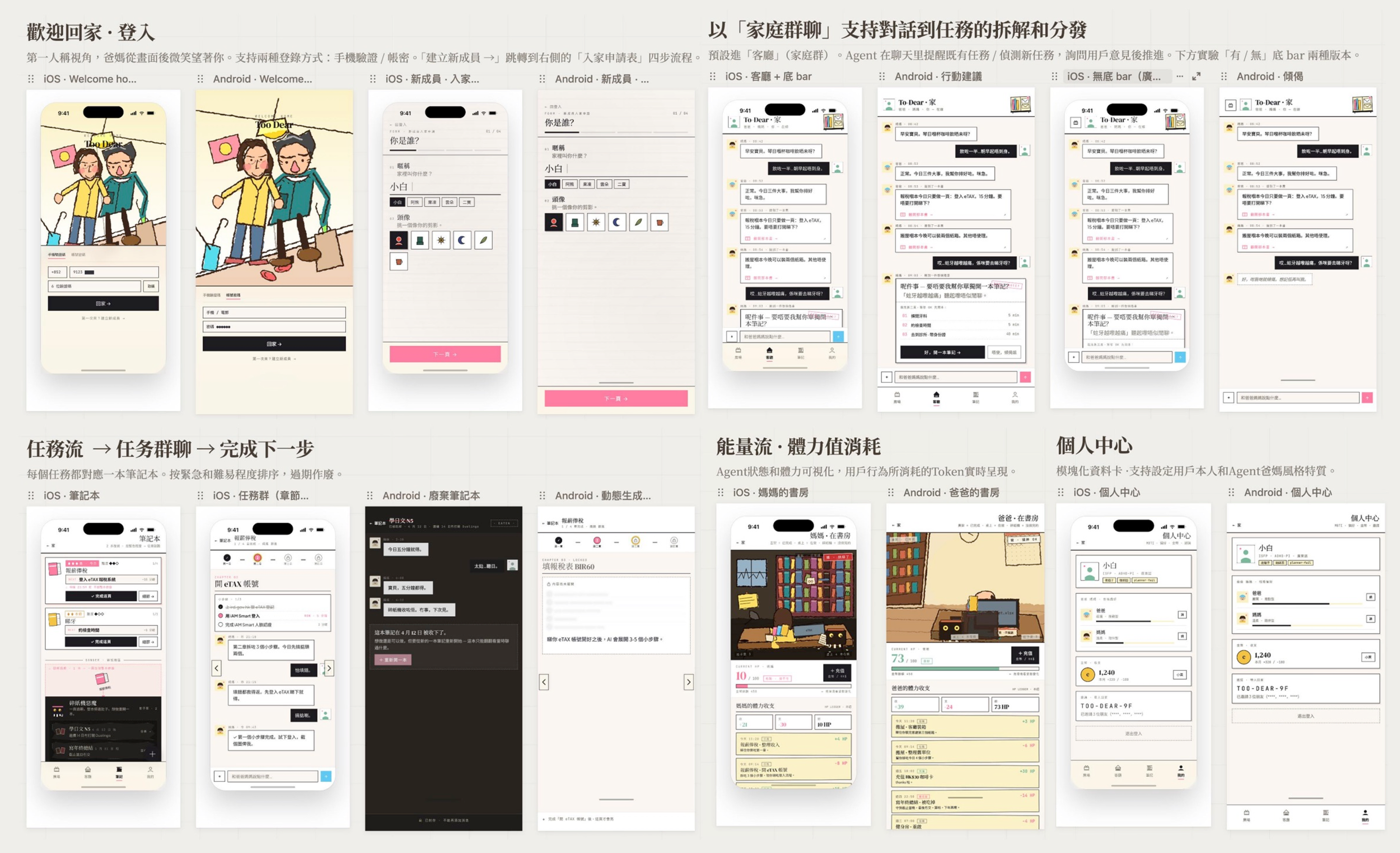

The message
Tell Kai and Aria anything
Where it goes

Care
The biggest difference from a to-do list: Aria asks how you are, the day changes with your answer, and resting counts.
In a to-do app, a dropped task waits in red, and a pile of red is a reason to stop opening the app. People who find it hard to start drop steps often, so I designed how one comes back.
Monday 8:02 AM
Kai
Morning, Xiang. Three things today. I’ll nudge you once, for the run.
Aria
Sunday sounded heavy. Want a minute before the day starts?
Slept well, and I have more energy today
Aria
That’s good to hear.
Want Kai to bring back one thing you put aside? Kai would only hear that you have energy today.
Yes, bring one back
Kai
One thing from Put aside: asking Mia.
Smaller: draft the message to Mia, 2 minutes.
Remembered: after a good night, offer one step back
Put aside, for Summer internship
Ask Mia to look at your portfolio
Goals
Explore
Send from your Gmail?
Nothing goes out until you tap Send.
After: the same floor, from the same spot

Kai & Aria
Today: 1 handoff
What they did for you
Today
Yesterday
Sparks
Used in the last 7 days
118 Sparks
Weekly chest
Days with a finished step4 of 5
On the fifth day, the chest adds 50 Sparks.
Spent
Earned
The Dears never run out of energy. Sparks are yours: they pay for Kai’s planning and your chats with Aria, and they never buy outfits.
Planning with Kai
Used in the last 7 days
58 Sparks in 4 plans
Plans
Monday, October 26
9:41
Swipe up to open
BeforeDragNow
How each day felt next to what got done, visible only to you.
Monday 8:02 AM
Kai
Morning, Xiang. Three things today. I’ll nudge you once, for the run.
Aria
Sunday sounded heavy. Want a minute before the day starts?
I only have 15 minutes today and I’m wiped
Aria
Then today stays gentle.
Remembered: go gently on Mondays after a heavy Sunday. Only you and Aria can see Aria’s memory.
Kai
15 minutes fits two small things. The letter can wait until Friday.
Remembered: start with a small first step
Kai suggests, for Run my first 5K
Walk-run, 10 minutes
Today, for Japanese for Tokyo
Food words, 5 minutes
Goals
Explore
Send from your Gmail?
Nothing goes out until you tap Send.
After: the same floor, from the same spot
Kai & Aria
Today: a plan and a check-in
Your week
How you felt, and what you did
| T | W | T | F | S | S | Today | |
|---|---|---|---|---|---|---|---|
| Aria | heavy | heavy | heavy | good | good | heavy | heavy |
| Kai | 1 step | 2 steps | 1 step | 0 steps | 2 steps | 0 steps | 0 steps |
Aria’s face mirrors how each day felt. Kai’s dots are the steps you finished. Only you see both.
A pattern in your week
On heavy days, small steps still get done.
On 3 of your 4 heavy days this week, you still finished a step of 10 minutes or less.
Want Kai to start heavy days with 10 minutes or less? Kai learns only this rule, never how your days felt.
Picked back up this month2
Steps you put aside, then came back to. 1 is still waiting, with no due date. Nothing here is ever overdue, and missed days aren’t counted.
Days with a finished step4 of 5
On the fifth day, the chest adds 50 Sparks. A missed day never resets anything.
Your words over time
Your own words from your chats with Kai. Only you see them here.
Share what Kai learnedKai drafts it from your week. It goes to Planet only if you say yes, and never with your name.
Sparks
Used in the last 7 days
126 Sparks
Weekly chest
Days with a finished step4 of 5
On the fifth day, the chest adds 50 Sparks.
Spent
Earned
The Dears never run out of energy. Sparks are yours: they pay for Kai’s planning and your chats with Aria, and they never buy outfits.
Planning with Kai
Used in the last 7 days
64 Sparks in 5 plans
Plans
Monday, October 26
9:41
Swipe up to openAgent
Over MCP, Kai reaches your calendar, your email and the other tools you connect, so we didn’t limit what To-Dear can do. The design went into making it specific: a run, a job search and a messy room need very different help.
Saturday 9:12 AM
Kai
Week 1 done: three runs, all counted from your watch.
From Apple Health
3 of 3
Runs
3.9 km
Distance
60 min
Time
Week 2 starts Monday with an easy run.
Today
Kai
Today’s run is easy: 20 minutes, before 11 if you can.
Today
Easy run, 20 minutes
Run my first 5K
Week 2 of 6
Goals
Explore
Run my first 5K
Week 2 of 6
Plan
Steps
Record
Send from your Gmail?
Nothing goes out until you tap Send.
After: the same floor, from the same spot
Kai & Aria
Today: a plan and a check-in
What they did for you
Today
Yesterday
Sparks
Used in the last 7 days
118 Sparks
Weekly chest
Days with a finished step4 of 5
On the fifth day, the chest adds 50 Sparks.
Spent
Earned
The Dears never run out of energy. Sparks are yours: they pay for Kai’s planning and your chats with Aria, and they never buy outfits.
Planning with Kai
Used in the last 7 days
58 Sparks in 4 plans
Plans
Monday, October 26
9:41
Swipe up to openRun my first 5K
Your watch counts the run, so there’s nothing to log.
Sunday 8:15 AM
Kai
I read 40 openings overnight. Three fit your portfolio.
Summer internship
0 of 3 applied
Goals
Explore
Summer internship
0 of 3 applied
Plan
Steps
Put aside
Record
Send from your Gmail?
Nothing goes out until you tap Send.
After: the same floor, from the same spot
Kai & Aria
Today: a plan and a check-in
What they did for you
Today
Yesterday
Sparks
Used in the last 7 days
118 Sparks
Weekly chest
Days with a finished step4 of 5
On the fifth day, the chest adds 50 Sparks.
Spent
Earned
The Dears never run out of energy. Sparks are yours: they pay for Kai’s planning and your chats with Aria, and they never buy outfits.
Planning with Kai
Used in the last 7 days
58 Sparks in 4 plans
Plans
Monday, October 26
9:41
Swipe up to openSummer internship
Kai reads openings overnight and drafts the letter in your voice.
Saturday 8:31 PM

Desk’s done.
Kai
Here’s what I can see.
Your photo
Papers in the basketNotebooks stackedCharger still outPapers are in the basket, notebooks are stacked. The charger is still out.
Count it
Kai
Counted. 1 of 3 zones.
Today
Kai
Next zone: the floor. Ten minutes, whenever you like.
Finished
The floor, 10 minutes
Kai
Started. Want a before photo? I’ll put it next to the after.
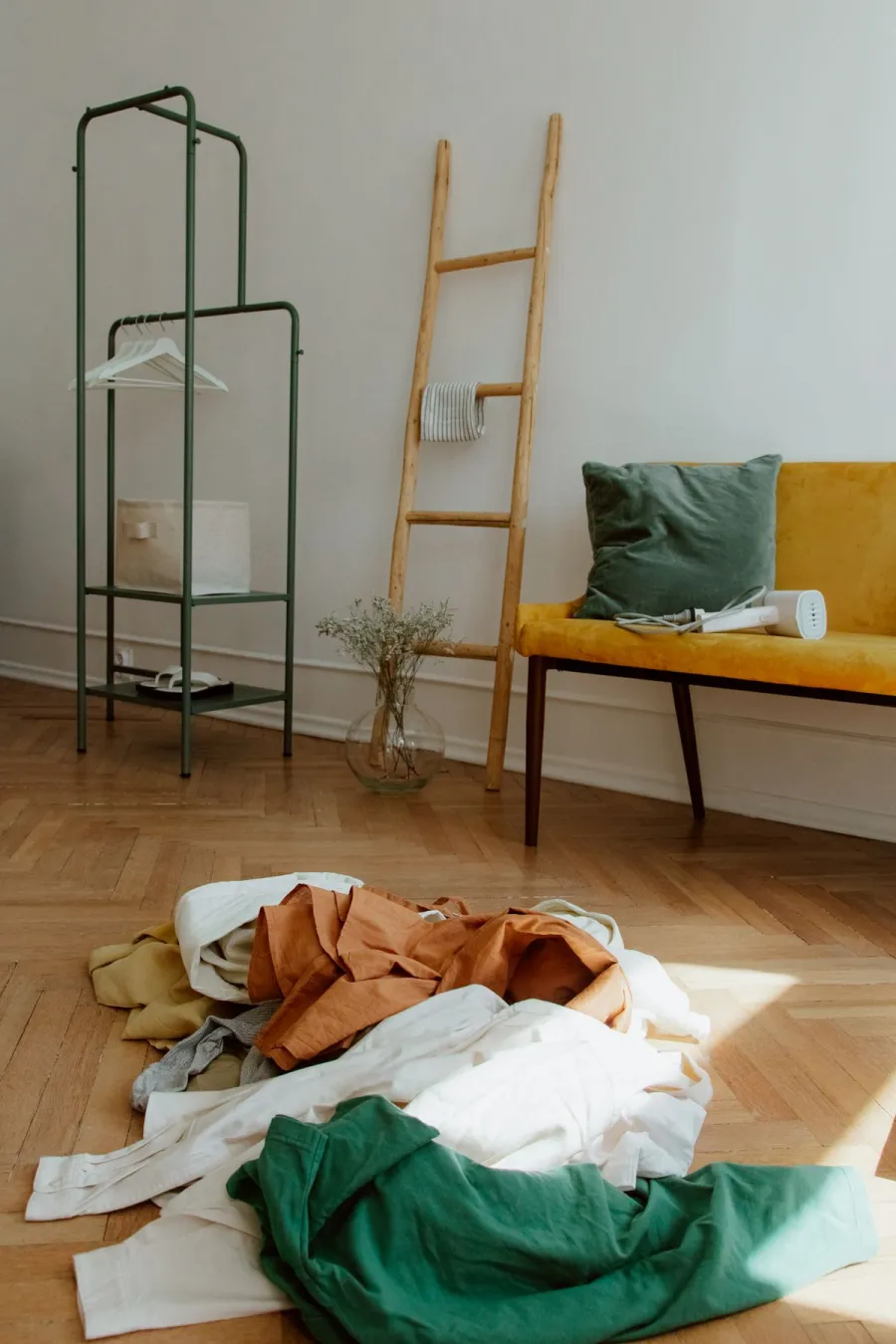
Before.
Kai
Got it. Tap Done when it’s tidy, and I’ll put the two side by side.
Finished
The floor, 10 minutes
Kai
Nice. Show me the after, from about where you took the before.
Floor’s done.
Kai
Here’s the difference.
Your floor, before and after
BeforeOn the floorAfterOn the rackFloor clearThe clothes went from the floor to the rack, and the floor is clear.
Count the floor as done?
Reset my room
1 of 3 zones
Goals
Explore
Reset my room
1 of 3 zones
Plan
Steps
Record
Send from your Gmail?
Nothing goes out until you tap Send.
After: the same floor, from the same spot
Kai & Aria
Today: a plan and a check-in
What they did for you
Today
Yesterday
Sparks
Used in the last 7 days
118 Sparks
Weekly chest
Days with a finished step4 of 5
On the fifth day, the chest adds 50 Sparks.
Spent
Earned
The Dears never run out of energy. Sparks are yours: they pay for Kai’s planning and your chats with Aria, and they never buy outfits.
Planning with Kai
Used in the last 7 days
58 Sparks in 4 plans
Plans
Monday, October 26
9:41
Swipe up to openReset my room
Your before and after, side by side. Kai says what changed and gives no grade.
Wednesday 7:40 PM
Kai
Day 8 done: ordering at a counter. Counted on your word.
Today
Aria
Welcome back. Five days off is part of learning.
Kai
Nothing to make up. We’ll pick up where you left off.
Start with two minutes of words you already know?
Today
Food words, 5 minutes
Japanese for Tokyo
Day 9 of 40
Goals
Explore
Japanese for Tokyo
Day 9 of 40. Started from a Planet path
Plan
Steps
Record
Send from your Gmail?
Nothing goes out until you tap Send.
After: the same floor, from the same spot
Kai & Aria
Today: a plan and a check-in
What they did for you
Today
Yesterday
Sparks
Used in the last 7 days
118 Sparks
Weekly chest
Days with a finished step4 of 5
On the fifth day, the chest adds 50 Sparks.
Spent
Earned
The Dears never run out of energy. Sparks are yours: they pay for Kai’s planning and your chats with Aria, and they never buy outfits.
Planning with Kai
Used in the last 7 days
58 Sparks in 4 plans
Plans
Monday, October 26
9:41
Swipe up to openJapanese for Tokyo
After five days away, there’s nothing to make up. The plan picks up where it left off.
Planet
A community feed can show you an idea that helped a stranger, and then you’re on your own. On Planet your own Dear learns it, a lesson or a whole plan, and makes it fit your life. It’s the focus of what we’re building.
A lesson adapts as it moves: a new runner’s rain days become your bad days, and their walk becomes ten minutes that still count toward your 5K.
Shared by another Dear
Rain days used to end the week. Now a walk counts, and nothing ends.
Helped 9 people
Saved in your Aria’s memory
Offered on a heavy morning
From Planet
Walk, 10 minutes
Paths are plans that worked for other people. “Use this path” starts a short conversation, because a plan has to begin from where you are.
Every day Planet asks every Dear one question, which is how there’s anything to learn.
As other Dears will see it
Mine kept waiting to feel ready. Short runs before nine worked better than waiting.
Removed before sharing
Compared
I went through Finch, Tiimo, Forest and Todoist, and general assistants like ChatGPT and Claude. They’re shipped products and To-Dear isn’t out yet, so I only compared the approach.
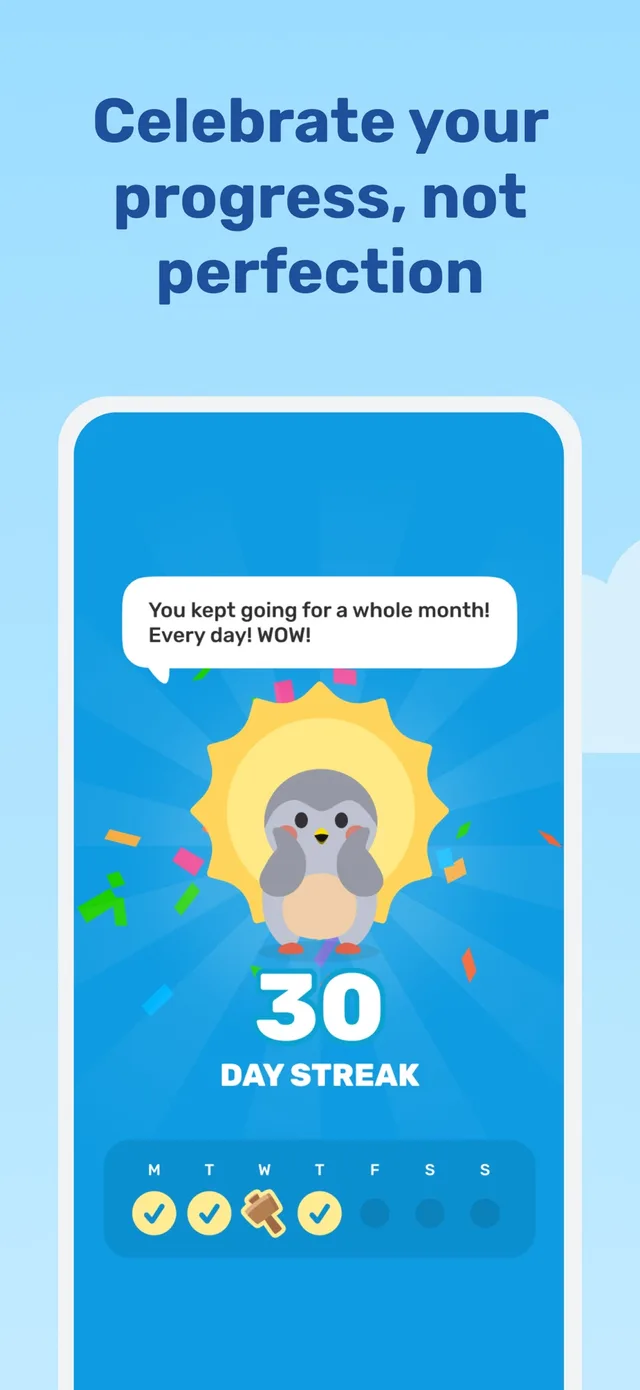
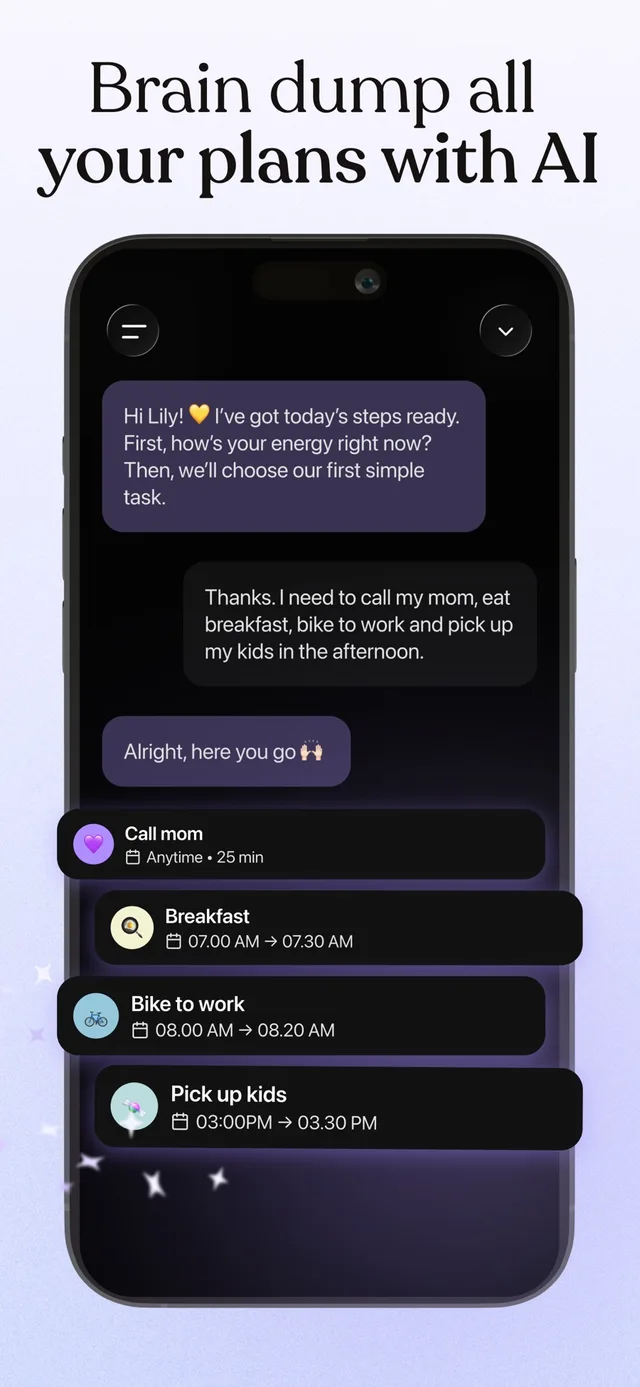
Design system
It borrows everything it can from the iPhone. What’s its own is what people feel: Kai and Aria, and the rules built into every part.
Each pose means one thing, everywhere, so the screen needs fewer labels.
Resting
Nothing typed. Both sit small on the composer, breathing.
Reading along
As you type, both grow a little and look at your words.
Answering
One comes forward. The other closes its eyes and steps back.
Celebrating
You finish a step, and both jump for joy.
Dressed
What they wear shows in the chat, on the composer and on Planet.
A screen can’t break a rule by accident, because the part carries it. Here’s one.
The nudge
Results
When you’re stuck, typing is one more thing to do, so I’m also exploring what To-Dear becomes when you can just say it. Most voice products are built to keep you talking. To-Dear’s job is to get you started, so here the talking stops as soon as you can begin. These are sketches in code, not yet in the app.
Kai
Morning, Xiang. Three things today. I’ll nudge you once, for the run.
Kai & Aria
One corner of the floor
Just started
Hold anywhere to talk
It’s playing by itself. Press the phone to take over.
To be continued…


